

Decarbonization
How groups in Quebec are thinking about a healthier planet
Jour de la Terre
À QUOI RESSEMBLERAIT UN QUÉBEC DÉCARBONÉ ? (click on the link to read in French).
Valérie Simard, LaPresse, 19 April 2026
If Quebec achieves its ambitious goal, we will live in 2050 in a decarbonized society. How will this affect the ways we move, feed ourselves and live in the territory? With the help of experts, we imagined the contours of this society.
Quebec, like Canada, has set itself the goal of achieving carbon neutrality by 2050. This target is not inscribed in the law, but it appears in the Plan for a Green Economy 2030.
According to the United Nations (UN), in 2024, 107 countries were committed to carbon neutrality (net zero emissions). This means that they should not emit more greenhouse gases (GHGs) than they can absorb.
In Quebec, with current technologies, there is no way to reach an absolute zero, says Éloïse Edom, a research professional at the Trottier Institute and an expert in energy modeling. The remaining emissions will have to be sequestered or compensated. However, in a world where most countries aim for carbon neutrality, compensation has its limits.
The current models from the Trottier Institute show that about twenty megatons of GHG emissions will persist in 2050 in Quebec. In 2023, the province's total emissions were about 78 megatons (millions of tons).
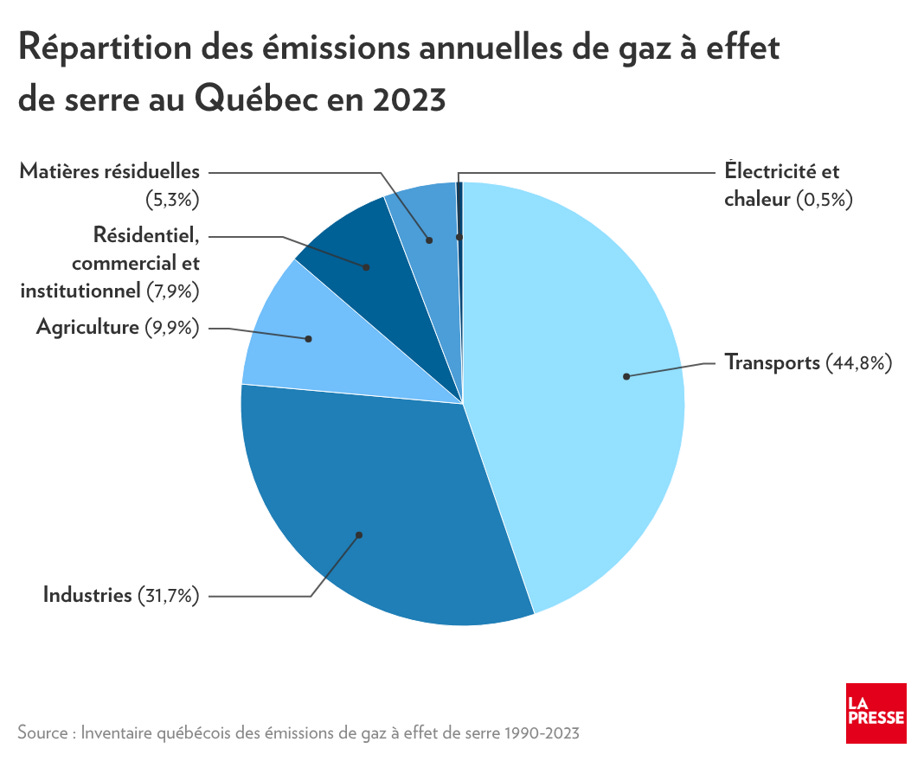
Why is it important? To avoid the most serious effects of global warming, science shows that the rise in global temperature must be limited to 1.5 °C compared to pre-industrial levels. To achieve this, in accordance with the most ambitious objective of the Paris Agreement, it is necessary to reduce emissions by 43% by 2030 and achieve carbon neutrality by 2050.
Major transformations are necessary. The trajectories are multiple and still unclear, which makes it difficult to present everyday life in a carbon-neuter society. However, this is essential for the adoption of innovative public policies. "From these possible futures, we try to see what they teach us for the present," says Christophe Abrassart, professor of design at the Faculty of Planning at the University of Montreal.
In France, the Agency for Ecological Transition (ADEME) conducted a prospective exercise called Transition(s) 2050. In 2021, she gave birth to four scenarios that, depending on whether we focus more on sobriety or technology, require different levels of societal transformation.
For example, the sober scenario shows that by adopting gestures such as a 70% decrease in meat consumption, a decrease in consumption and travel and a 30% reduction in the average area of new houses, carbon neutrality in France can be achieved without the use of carbon storage technologies.
On the other hand, relying hard on technology makes it possible to preserve most of our lifestyles, but at the cost of great uncertainty.
The Ministry of the Environment, the Fight against Climate Change, Wildlife and Parks is working on a similar exercise in collaboration with the Transitional Paths, a project of the University of Montreal and Space for Life. The final report, expected by the end of the year, should allow us to better understand the choices available to us.
Caution with technology
If technology certainly has its place in a decarbonized society, several experts warn against the risks of basing all our hopes on it. Carbon capture and storage still face economic, technological, institutional and ecological barriers.
"We can't keep habits and simply change technology," says Éloïse Edom. We need to review the infrastructure. ”
The other argument in favor of sobriety is that decarbonization is only one aspect of the socio-ecological transition. We should also take into account the planetary limits, including the loss of biodiversity and the water resources necessary to support our energy-intensive lifestyles.
"We must try to design solutions that are sustainable," says Pierre-Olivier Pineau.
Fair and equitable solutions too, advocates the Common Front for the Energy Transition (FCTE), a coalition that brings together environmental organizations and trade unions.
Through its Collectivités ZéN project, the FCTE accompanied nine communities, including Laval, the Gaspésie and Saguenay–Lac-Saint-Jean, in a social dialogue to plan the transition on a regional scale.
He does not only consult the convinced. Discussions are organized in companies, in schools and with municipal elected officials. One aspect comes up in almost all: "It is not technology that will save us, it is the transformation of our social relations and the transformation of our relations with the territory," summarizes Pierre-Luc Baril, in charge of the development and support of the ZéN Communities.
Since the experts consulted also agree on the need to move towards sobriety, it is this approach that we have adopted to imagine a decarbonized Quebec.
~~~~~~~~~~~~~~~~~~~~~~~~~~~~~~~~~~~~~~~~
A CALCULATION THAT HAS ITS LIMITS
Like many countries, Canada and Quebec use the territorial approach to account for their GHG emissions. This means that GHGs emitted during the manufacture of imported goods and international air flights do not appear in our carbon footprint. Several experts believe that a consumption-based calculation is more accurate and representative. Recent work by the International Reference Center on Life Cycle Analysis and Sustainable Transition (CIRAIG) shows that the carbon footprint of Quebecers is 9.6 to 14.4 tons eq. CO2 per year, according to their income. However, to achieve the objectives of the Paris Agreement, each inhabitant of the Earth should not emit more than 2 tonnes eq. CO2 per year.